Friday, April 27, 2012

What BYOT Looks Like: A Photo Series


after the #BYOTchat about marketing, the @40ishoracle came up with the idea of the photo essay. We will be posting these photo essays of BYOT at Brebeuf Jesuit on JD's fancy new Pinterest Board

Should we expand this to include more schools? Feedback always welcome :)


Source: Uploaded by user via JD on Pinterest

The Vendor Corollary to Lord-of-the-Flies: an open letter to edtech companies on Twitter

Save Our Tweetups
When the head of the Indiana Department of Education and I agree completely on something, it is a special time. So when I heard him refer to twitter as an excellent source of professional development, I noted it as that rare convergence of educational worldviews.

I currently devote about 5 hours of my life (more for curation) each week to the low-impact professional development, personal learning networking, and link-and-learning available on Twitter. Hastag chats are near and dear to my geeky little heart: #byotchat, #edchat, #flipclass with a strong pull to #isedchat, #pblchat, and, if i ever figure out when they regularly converge I will add, #digcit and #edtech.

These are great places to be affirmed, to learn new techniques, to ask questions, and to pull tons of resources (which i routinely tag and then go back to read and add to @pearltrees -- although they need an ANDROID app in such a bad way. *hint*).

But, in a variation of what often happens in a capitalistic society, whenever two or more are gathered in the name of anything, someone is going to try to sell you something. And so, it is with a heavy heart but a great deal of optimism over the power of the human spirit that i offer this corollary to my Social Media Lord-of-the-Flies Rule: Student, left to their own devices in social media, will create their own norms of behavior.

The EdTech Vendor Corollary: 

Educational Technology Vendors, without guidelines of appropriate conduct, will attempt to hijack, dilute, and flood every professional development opportunity. (or something like that)

Follow the Trends:

This has happened in all sorts of social media spaces. I was following the trend with mommy-bloggers a couple of years ago as the social media mommy market exploded and the brands took notice. Over the course of time  I saw partisan lines develop over the affiliation with branded products, I saw an increasing amount of posts about that issue rather than about the things that made mommy-blogs popular, and i watched  new entrants to the medium fail to see value because it had been diluted with pitches, thinly veiled paid endorsements and little real content.

This happens with celebrities too. Fans like to follow the real lives of celebrities and call foul when a celeb who has been so good at interaction and personal sharing gives the account over to a professional media company. The cool and slick varnish of a marketing person sticks out like a sore digital thumb in the twittersphere. I have not investigated if there is a decline, but i have seen the backlash first hand.

My Proposed Rules of Conduct for #EdTech Vendors:

1. Keep Chat Times Generic Ad Free
It is to the advantage of an advertiser to post information when the most eyes are looking at it. This rules has been true since the Mad Men days. Thus it makes sense that Advertisers will want to set up their auto-ads to play when fifty or a hundred or a few hundred are looking rather than just a few.

But when i log into #edchat, it is with dread that i wait through the rush of generic ads from vendors large and small that often have absolutely NOTHING to do with the topic which has been voted and deliberated by educators who are a part of the community.

Solution: use the 5-10 minutes before the chat and after the chat. Many of us log in early and stick around afterward. Those who visit later scroll through. It's not as many eyes, but you will get more respect from those of us in a position to take advantage of your services.


Wednesday, April 25, 2012

Teaching the (non)Controversy Part II: Information Literacy in the Age of Infowhelm

In Part I we looked at the way that information gathering and viewing has changed in such a way that we need some fundamental changes to how we teach research. To Recap:

  1. In the pre-information age, there were gatekeepers through editors, universities, etc. to wide print/publication and distribution. Information was generally vetted through these sources. While these gates still exist, they now compete with self publishing and alternative sources of information that do not filter.
  2. As it does in academia, there was a general trend for ideas to come into and fall out of favor based on their popularity and validity. Ideas that fell out of favor had a difficult time coming back in vogue. Ideas, particularly ideas at the fringe of conversations often remain in the social dialog through archives, Google searches, message boards, etc.
  3. Competing objectives such as ratings and pageviews have made the desire to have a matter "settled" take a back seat thoroughly examining every opinion and idea on the matter. These ideas, readily available as a result of the archiving of all thought on the internet, can be brought back to the public discourse as needed 
It is in this environment that we must teach our students to find, validate, and report on research.

Interlude: Oh, and Another Thing -- The Wikipedia Conundrum

Where were you the day Wikipedia went dark?
Under the traditional research methodology, Wikipedia stands out as clear violation of the gatekeeper mindset. The crowdsourcing of information stands in stark contrast to the vetted-by-publisher mentality. Thus we spent many years in education pointing out how easy it was to corrupt the system while Wikipedia and millions of users spent the years making the system harder and harder to game. 

In 2006, Thomas Chesney made an empirical analysis of Wikipedia, determining that 
"the experts found Wikipedia’s articles to be more credible than the non–experts. This suggests that the accuracy of Wikipedia is high. However, the results should not be seen as support for Wikipedia as a totally reliable resource as, according to the experts, 13 percent of the articles contain mistakes."
other similar research has put forth increased accuracy claims and comparative claims with more traditional reference and technical resources. There are two important things to draw from this:

  • First, our credibility goes down when we criticize Wikipedia as "unreliable" when the students' lived experience is that it is highly reliable for most things.
  • Second, we miss out on the opportunity to investigate the weaknesses of Wikipedia (heated political issues, issues with a high degree of interpretation of specific terms or ideas, current events) when we dismiss the platform as a whole.

[End Interlude]


Monday, April 23, 2012

Teaching the (non)Controversy Part I: A Marketplace, Corrupted

In celebration of passing 5,000 page views on my blog (THANK YOU SO MUCH), I thought I would change things up a little by mixing the typical rant up with a problem that I don't necessarily have an answer for yet.

(Please note, I will be writing about "controversy" in this blog. Please take the content of my claim into consideration even if you disagree with the examples)

But first, check out my Pin (Pinterest Board)!:

(ok, in all honesty, I am also trying to figure out a use-case for Pinterest in education as well. According to some of my students I won't get it, because I am a not a girl...ha!)

Interlude 1:

One of our numerous resources
The debate topic a few years ago in Lincoln-Douglas was over mandatory vaccinations. As we clarified issues such as individual autonomy and social responsibility, the topic of Autism kept coming up. As all good coaches and competitors do, we went to the research, eventually focusing on two sources: Autism's False Prophets and The Vaccine Book. One of the fascinating things we learned through these sources, peer reviewed journals, discussion with physicians, etc. was the "controversy" of the link between Autism and Vaccination was non-existent -- there wasn't a link.

Despite other books
Despite celebrity spokes people
Despite air time on evening news programs and screen time on websites

The scientific community had put this "controversy" to rest through the process of epidemiological study, scientific method, and peer review. But if you google this topic, the controversy appears to be live and well.
In fact, the third link (when I looked it up for this blog) refers to a March 2011 study published in a peer-reviewed journal that "sheds new light" -- It actually appears to affirm a number of the issues with the original Autism-Vaccine link claims but studies other areas that could be open for investigation.
[End Interlude]

Thus, the full understanding of this issue (which I do NOT claim to have) would require a careful study of published literature, a grasp of the process of Peer Review and its relationship to the scientific method in assessing the validity (or invalidity) of various hypothesis, and an ability to carefully and closely read information beyond the first few paragraphs and analyze carefully the implications of a statement.

Sounds like 21st Century skills to me.

Teaching the (non)Controversy - What went wrong?

I think there are a  lot of issues that are at play here, not the least of which include strongly held religious beliefs that may come into sharp contrast with commonly accepted scientific theories (see how I just went there with evolution without making it the focus of my essay? #savethedinosaurs). I am not going to focus on that one, but instead want to look at  how the information age has influenced this issue.

First, Back in the pre-PC days, it was difficult to get writing (any writing) in front of a large number of readers. Most academic publishing was controlled by universities and, because of the practice of Peer Review and the necessity to maintain an academic reputation, it was difficult for theories to be published without strong scientific grounding. Thus, if you were researching information in a library, it had likely gone through an editorial process or a full-bore system of Peer Review.

Second, there was a lot less news in those days: fewer channels, no Internet, and no 24/7 news cycle. Additionally, the news was not in intense competition for nielson ratings and page views as a primary driver. With less competition, news agencies could afford to be less sensational.

Third, if you did have an extreme minority opinion and you did want to exercise your 1st amendment right to throw that idea out there, your method of transmission was severely curtailed. The paper flyer you hand out on a street corner lends some opinion on the validity of the thought in most people's minds.

Fast-forward to 2012. There is more information created in a single day than a human being could ingest in his or her entire life. Much of this information is unvetted through either a publisher's editorial department or the formal peer review of academia. The Internet has become the great publishing equalizer, allowing people's opinions to appear as fact and ideas without evidence to exist with the same amount of shiny and pretty (and sometime even more) as venerated news agencies, academic publications, and scholarly research.

In this environment, news agencies are fighting for every precious eyeball. While we like to pretend that we each want more feel-good stories, ratings go up when there is human drama and the best way to initiate this on a news show is to have two or more people yelling at eachother over their heartfelt beliefs. Thus, the creation of "equal time" policies serve the dual purpose of showing "all sides" of an issue while creating a system most likely to create entertaining television. The flaw in this system, of course, is that careful consideration must be made to determine just how big that other side of the issue actually may be.

Monday, April 16, 2012

Practically Applied: Digital Media Project -- Criticism and Creation

This is a new type of blog post that I am working on, a variation on the #FLIPCLASS DIARY theme where I am attempting to give some technology integration lessons in a simple format, focusing on the overview, applications used, and impact on the lesson.

In all honesty, i am also trying to avoid doing taxes so I am guaranteed to accomplish that goal at least. As always, love the feedback (here or on social networks) and the Retweets. I am beginning to gauge which blogs are working (Flipclass and BYOT commentary) and which ones don't (3 rants in a week cannibalize on themselves).

Creating a Multimedia Presentation - Part I
Objective: Students will create a multimedia presentation that includes narration, text, photographs with the option of adding video and secondary audio.

Primary Tools:
Multimedia creation: iMovie, Windows Movie Maker, PowerPoint, weVideo

Secondary Tools:
Storage and Sharing: Box, Dropbox, Google Docs
Audio Capture: Soundcloud, Audacity, PowerPoint
Picture Editing: Picsay Pro, Skitch, Google Docs Drawing, PowerPoint

Classroom Applications and tools:
Todaysmeet.com - Backchannel
Google forms - Group assignment and prelection
Post-it paper and markers

Prelection and Context Setting: Preview and Day 1
[Note: my favorite part of this lesson]

Overview: many of our students come into highschool with a pretty decent formal or informal ability to create multimedia production in either PowerPoint or one of the basic movie software programs. What seems to be missing is the ability to think about the projects in terms of quality, achievement of message, or goals beyond completion.

Students were assigned to read the Isaac Asimov Essay, "The Relativity of Wrong". Its a great essay for high school students and has some nice things to say about the state of assessment in education. (the copyright of this is still bothering me, but it is out there so...)

Today's meet provides instant backchanneling
for live discussion
We created a backchannel using Today's Meet. I love backchannels so much more than clickers. Backchannels empower students to give more than a fill in the blank response and give them the opportunity to engage withe each other as well.

a few pointed reading check questions were asked to start things off:

  • What is the overall point of the essay? What does the author want you to come away with?
  • What is one description, example, or point that is made that struck you as insightful or interesting?
This puts students into the mode of responding and gets the neurons firing. It also served as a setup for the next section. 

Students then watched a YouTube video of "Relativity of Wrong" created by a fan of the essay. I was very explicit to explain to the students that i thought there were some things executed very well and some things that need a lot of work.

As they watched the video, they were to fill in the back channel with observations about the presentation. They were to focus on what was executed well and what needed work to improve it. Through the course of the backchannel (11 pages long when printed) the students pointed out on their own, elements that would have made any English teacher...well, any teacher...proud:
  • Too much text and the screen
  • Monotone voice
  • Could use some animation
  • Good use of photos to underscore ideas
After the backchannel, we reflected on the ideas presented. Students developed their own set of working guidelines for making a presentation (Dos and Don'ts). From a social media/digital citizenship side, the students were able to criticize without personalizing and even complimented others on good points.

Homework: Find an essay, piece of writing, portion of book, etc that you will use to make a five minute multimedia presentation from. 

Preparation and Storyboarding: Day 2-3

The next day, students created small group and discussed each individual idea for its pros and cons. Many of the elements identified the day before came up in the discussions (practical reinforcement) and students began to discuss their plans. By the end of the day, each group had filled out a GoogleFORM (survey) that identified groups, topics, initial themes and focus points.

One of the more popular tools we demo is a
mobile App for ANDROID called Picsay Pro
#FLIP video: Preparation That night, students watched a flip video that gave them an overview of non-linear video creation (this is the most common type of video/multimedia, used in iMovie and Windows Movie Maker among others). The video also previewed the use of a number of tools that would be good options for adding captions to photos, simple animations, and sharing the files that students would be collecting for their projects ("the bin").*

*NOTE: this is key to a #BYOT environment. It is not about teaching the specific buttons to push. it is giving the overview that allows student the time and the space to experiment with tools.

In-class: Storyboarding After a brief demonstration that walked students through the basics of storyboarding, they were off to work on their own. I was able to meet with each group at least three times over the course of the next day and a half of class. During these discussions we talked about advantages and disadvantages of specific tools, questioned the level of specificity on some of the boards (and how the lack of detail might cause more work later on).
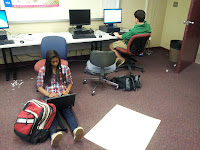
Again, the focus was not on the specific tools that were being used. Most groups had the basics down. And for students who were struggling with a specific technique, it was much simpler and more effective to show that one students (and any others interested in learning a specific process).

By the end of Day 3: most groups had completed their preliminary Bins of material to include. A number of students had begun working on captions and title slides. One group had decided, based on the types of transitions and animations that they were planning, that they would be better off using PowerPoint, with its numerous transition and motion effects rather than iMovie which was more limited when dealing with 5 simultaneous effects on 5 different photos.
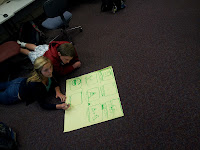
Over the weekend, no homework was assigned, but a number of groups had created a GoogleDoc that was shared in order to write voice-over scripts and hash out any details they needed before production began in earnest.

Reflection:
So far, I have been very pleased with this assignment. It has allowed the students to focus on the objectives of the project (creating an effective multimedia presentation) by empowering them to use the tools with which they are most comfortable.

Beyond this, they have found a benefit in planning, preparing ahead of time, and working collaboratively in real-time and asynchronously.

This week, students will close the loop by reviewing each group's creation for message communication, technique, and overall message -- the same as was done during the prelection exercise.

Please feel free to Like, Comment, Repost, Retweet, +, etc. As always, we are interested in feedback and commentary. I would love to know if this type of post is useful to my tens of followers -- and if you are interested in a part II. :)